Case Brief or Margin Map: Pick the Tool for the Question
A case brief or margin map can make dense legal reading clearer: match the tool to whether you need to trace a court’s reasoning or connect concepts.
Case brief or margin map? If a judgment leaves you with highlighted passages but no clear account of what the court did, choose the format that matches the work you need to do: reconstruct a decision or compare ideas.
A brief turns a decision into a chain of reasoning
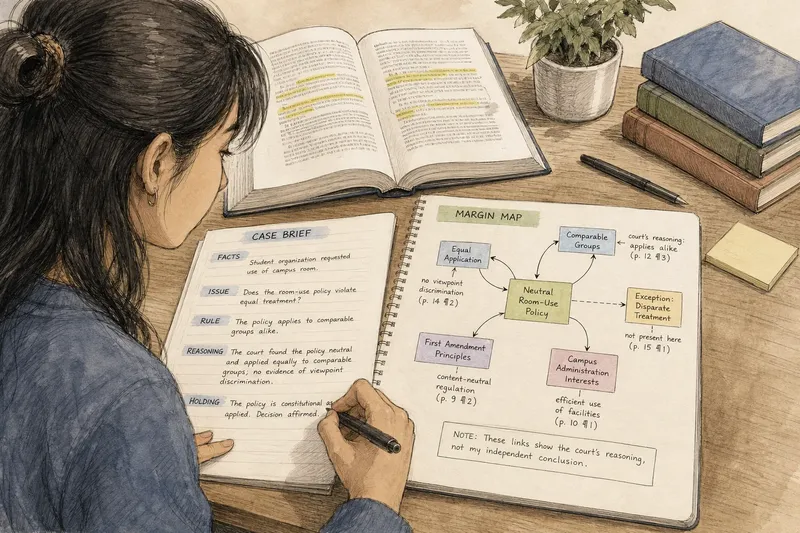
A case brief is a compact record of a judicial decision: relevant facts, the legal issue, the rule, the court’s reasoning, and the holding. Its linear order helps you see how the court moved from a dispute to an answer.
The brief is useful when you need to explain one judgment, compare its holding with another, or prepare to discuss why the court reached its result. It is less useful for showing relationships among ideas scattered across a reading or several course materials.
A margin map makes relationships visible
A margin map uses short labels, brackets, arrows, and links to show how claims fit together. You might mark a rule and its exception, contrast two arguments, or connect a legal concept to an economics concept.
Keep the map tied to the text. Distinguish what the court says from your own interpretation, and add a page or paragraph reference beside important links. Otherwise, a tidy web of arrows can blur the author’s argument and your response to it.
The format should match the job
Use a brief when the task asks you to explain a holding or trace a court’s logic. Use a map when it asks you to connect concepts, compare arguments, or show how a rule relates to an exception. If an assignment asks for both, make each tool answer a different question rather than copying the same notes twice.
Imagine you are reading a fictional appellate decision about a student organization’s request to use a campus room. Your starting material is a passage stating that the room-use policy applies to comparable groups alike, plus an assignment asking why the court upheld the decision. First, you write a brief with the issue, the policy rule, the court’s reasoning about equal application, and the holding; the result is a clear sequence you can explain aloud. Then you draw a small map linking “neutral policy” to “comparable groups,” with a note that this is the court’s reasoning, not your independent conclusion; the result is a visible connection without confusing it with the full decision.
Which format fits your reading task?
Should I brief every case I read?
No. A full brief makes sense when you need to explain or compare a decision’s reasoning. For a supporting case, a short note on its rule and relevance may serve the task better.
Can a margin map show a court’s reasoning?
Yes, if you arrange the court’s moves in order and label the links clearly. If you need to preserve a complicated chain for later explanation, a brief will usually be easier to follow.
What if a case connects to several course concepts?
A map can place the decision beside each concept, with a label such as “exception,” “limit,” or “trade-off” for every connection. Keep the holding separate from your interpretation of what the case means for the course.
Can I use both tools for one reading?
Yes, when each has a distinct purpose: a brief can preserve the decision’s logic, while a map can show how its ideas relate to other material. Skip the second format if it would simply duplicate the first.
Check whether the notes preserve what matters
For a brief, check whether you can explain how the court used the relevant facts to apply the rule. If you have the rule and holding but cannot state that connection, revise the reasoning section rather than adding more background.
For a map, check whether each arrow names a real relationship in the text and points to a passage you can find again. If a link is only an association you invented, label it as your interpretation or remove it.
Case brief or margin map is a choice about the shape of the answer you need: a brief preserves a decision’s sequence, while a map displays relationships. Keeping those purposes distinct makes it easier to select a useful format when a new assignment changes the task.