A First-Semester Reading Route for a Dense Course
A first-semester reading route helps you connect dense economics and law readings to class tasks, choose what to review, and prepare focused questions.

How do you prepare for a dense first-semester reading without spending the whole evening highlighting? A first-semester reading route at Trường Đại học Kinh tế - Luật starts with the next class task, then turns selected material into a question or note you can use.
The goal is not to make every page equally familiar. It is to decide what needs close attention, what can wait, and what you want the lecture to clarify. A simple route also helps when a course moves between economic models, legal concepts, cases, and problem sets.
Choose a target from the next class task
Begin with the syllabus, course schedule, learning objectives, and any directions from your lecturer. Identify what the next meeting asks you to do: apply a model, compare concepts, discuss a case, or work through a problem. Let that task shape your reading target rather than treating completion of every page as the only measure of preparation.
Next, scan the assigned textbook section, lecture slides, case materials, or problem set. Note how they connect. A chapter might introduce an idea that the slides apply, while an exercise asks you to use it in a new setting.
Put the target in Google Calendar, a paper agenda, or a spreadsheet beside the source and the section you plan to prepare. If the lecturer changes the emphasis, update the plan. A route should follow the course, not become another assignment to obey mechanically.
Sort passages by the work they do
Before reading closely, identify the passage’s purpose. Is it defining a term, explaining a relationship, presenting a model, comparing positions, or applying an idea? That quick classification tells you what to look for and what kind of note will be useful.
- For a definition, check whether the text distinguishes the term from a nearby concept. If it does, record the distinction; if not, flag the boundary for class or consult the course glossary.
- For an economic model, identify its assumptions and stated result. If the connection is clear, note how the assumptions support the result; if not, mark the unclear link to revisit in lecture or office hours.
- For a comparison, find the basis on which the alternatives are being compared. If the text names one, organize your note around it; if it does not, list the features that remain unclear and ask which matter for the course task.
- For an application, locate the facts or conditions tied to the conclusion. If the text explains the reasoning, trace that link; if it skips a step, mark the gap instead of copying the outcome as a rule.
- For unfamiliar vocabulary, check the course glossary or a source recommended by your instructor. If the definition fits the sentence, reread the passage with it in mind; if it does not, ask how the course uses the term.
- For a difficult paragraph, read the sentence before and after it and check the section heading. If the point becomes clear, add a brief note; if not, record the page and a specific question to bring to class.
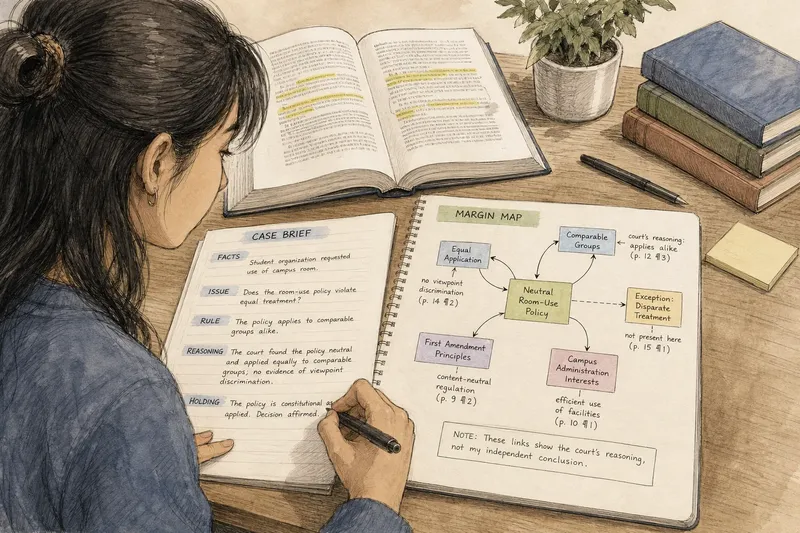
Use a pencil, OneNote, or Adobe Acrobat to mark only the sentence or passage that supports a concept, qualification, or question. A small, purposeful annotation is easier to revisit than a page colored from edge to edge.
Prepare one question that can travel into class
Turn your reading into a compact prompt: a model assumption you want applied, a distinction you want clarified, or a connection between sources you cannot yet see. Add a page or section reference so you can return to the passage quickly.
Say you have a class meeting on incentives and a reading about how a constraint shapes a decision. You mark the assumption that the constraint is present and write, “What changes in the model if this constraint is removed?” In class, the lecturer compares the two conditions; you add the resulting distinction to your notes. The prompt has turned a broad reading into a specific point you can use in a later exercise.
Bring the question with the source, but stay open to the discussion taking another direction. Listen for a clarification, a new condition, or a different application. If class does not address the prompt, keep it for office hours or the course’s designated discussion space.
Let lecture notes capture what the reading did not
Record what class adds: an application, a qualification, a distinction, or a connection to another topic. You do not need to copy the textbook and slides again. A brief note such as “lecture applies model to a new case” can point you back to the added idea.
For economics, note which assumption, relationship, or scenario the lecturer emphasizes. For law, record how the discussion interprets a principle or clarifies its scope. Follow the instructor’s terminology and assigned method of analysis.
If the reading and lecture seem to conflict, keep both claims visible until you understand why. They may refer to different conditions, interpretations, or stages of an argument. Bring the two passages to class or office hours and ask what explains the difference.
What should you adjust when the route stalls?
What if the reading is longer than the time available?
Check the syllabus and instructor’s directions, then identify the material most closely connected to the next class task. If full preparation is required, schedule another session and note what remains; if the instructor names a priority, begin there and keep the unfinished sections visible.
What if several concepts seem equally important?
Look at the course objective, problem set, or planned discussion to see which concept supports the others. If the materials do not make the priority clear, prepare one focused comparison and ask how the concepts relate.
What if a note no longer matches the lecture?
Keep the original note and add the lecture’s correction or qualification beside it, with a reference to the discussion. If you cannot tell whether the new point replaces the old one or applies under a different condition, ask the instructor before treating it as settled.
What if a digital annotation is hard to find?
Name the file with the course and topic, then add a page or section reference to the note. If you still have to search through several files, create one index in OneNote, a spreadsheet, or a paper notebook that points to each source.
End each session with a clear handoff
After class, compare your prompt with the next assignment, discussion, or scheduled topic. Decide whether the idea needs a correction, another pass through the source, or a question for your instructor. That decision gives your notes a destination instead of letting them pile up without a next use.
Before closing your materials, leave yourself a short handoff: the source to reopen, the concept to check, and the task that will use it. A first-semester reading route works best when it follows the course’s actual demands, so let the syllabus, your lecturer’s guidance, and unresolved questions shape what you read next.